

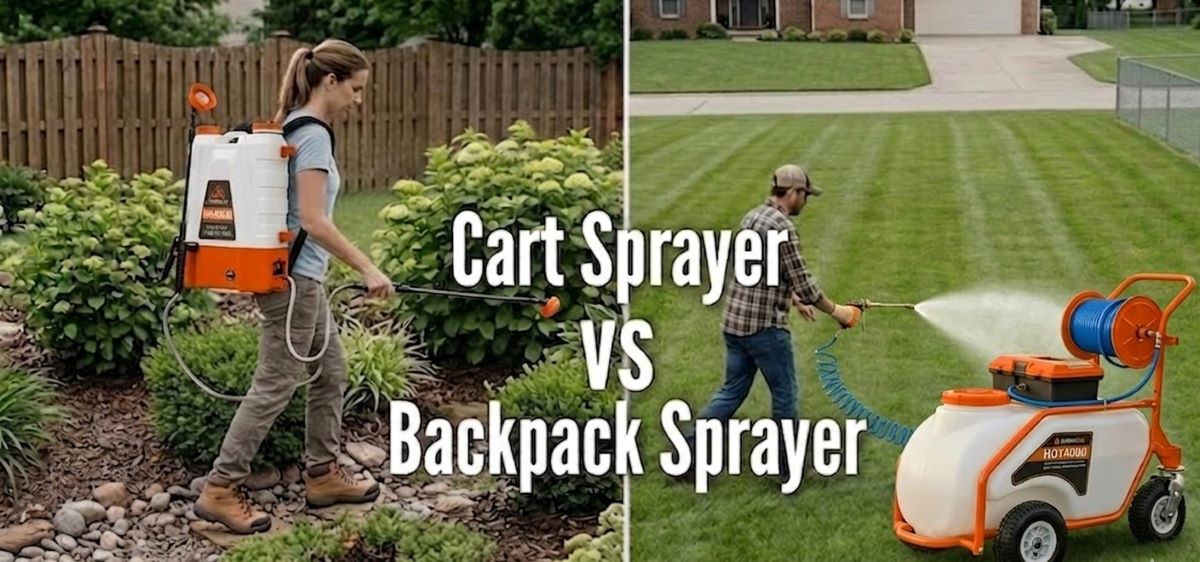
What’s the Real Difference Between a Cart Sprayer and a Backpack Sprayer?
Most people don’t start researching sprayers because they’re curious.
They start because they’re tired of using the wrong tool for the job.
Maybe you’re covering more ground than expected. Maybe hauling a tank on your back feels inefficient. Or maybe you’re looking at larger property maintenance and wondering if a wheeled setup would save time.
The decision between a cart sprayer and a backpack sprayer comes down to how you move across your property, how much you’re treating at once, and how often you plan to spray.
This guide breaks down when each type makes sense, where they perform best, and how to choose the setup that actually makes your work easier, not more complicated.
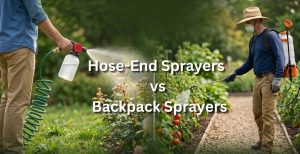
At a glance, both tools apply liquid treatments like fertilizer, herbicide, pest control, or lawn solutions. The difference is not in how they spray, but in how you move that spray across your property.
- A backpack sprayer moves with you.
- A cart sprayer moves with you on wheels.
That single distinction changes workflow, comfort, refill frequency, and suitability for different landscapes.
Think of it less like choosing tools and more like choosing how you want to work across space.
Today’s models in this category are battery powered, meaning they maintain consistent pressure without manual pumping, so the real difference comes down to how you carry, move, and apply the solution across your property.
Once you understand that movement is the real difference, the right choice usually becomes clear based on how your property is laid out.

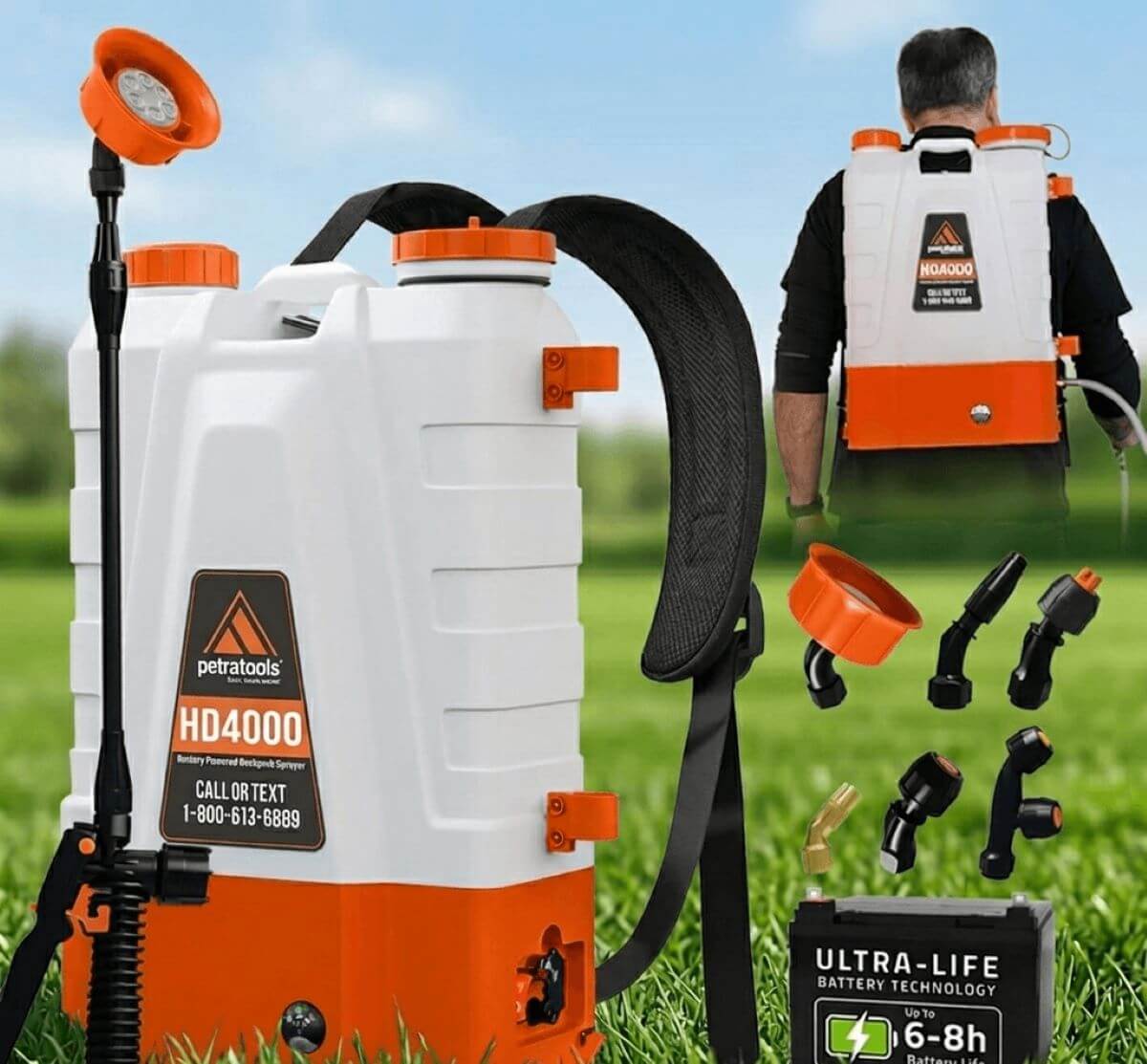
PetraTools HD4000 Backpack Sprayer
Best for: Lawn care, pest control, property maintenance
Key features: 4-gallon tank, adjustable pressure, rechargeable battery
Availability: In stock for $199.99
Buy ProductWhen a Backpack Sprayer Makes More Sense
Backpack sprayers are built for mobility and control. They excel where terrain, obstacles, or precision matter more than tank capacity.
Ideal Use Cases
- Properties under ½ acre
- Landscapes with beds, slopes, or tight paths
- Spot treatments or targeted applications
- Areas with steps, fencing, or uneven ground
- Users who want maximum maneuverability
Why Homeowners Choose Backpack Models
You are carrying the weight, but the weight is distributed evenly – and you gain excellent control. No dragging hoses. No managing wheels. Just move and spray.
For many homeowners, something like the PetraTools HD4000 Battery-Powered Backpack Sprayer becomes the everyday driver because it balances tank size with comfort and runtime without feeling oversized.
Advantages of the Backpack Sprayer
✔ Navigate anywhere you can walk
✔ Faster setup and cleanup
✔ Excellent for mixed terrain
✔ More precise application control
✔ Less equipment footprint in storage
Limitations of the Backpack Sprayer
✘ Smaller tank means more refills on large areas
✘ Weight is carried on the body
✘ Not ideal for repeated long spray sessions
When a Cart Sprayer Becomes the Better Tool
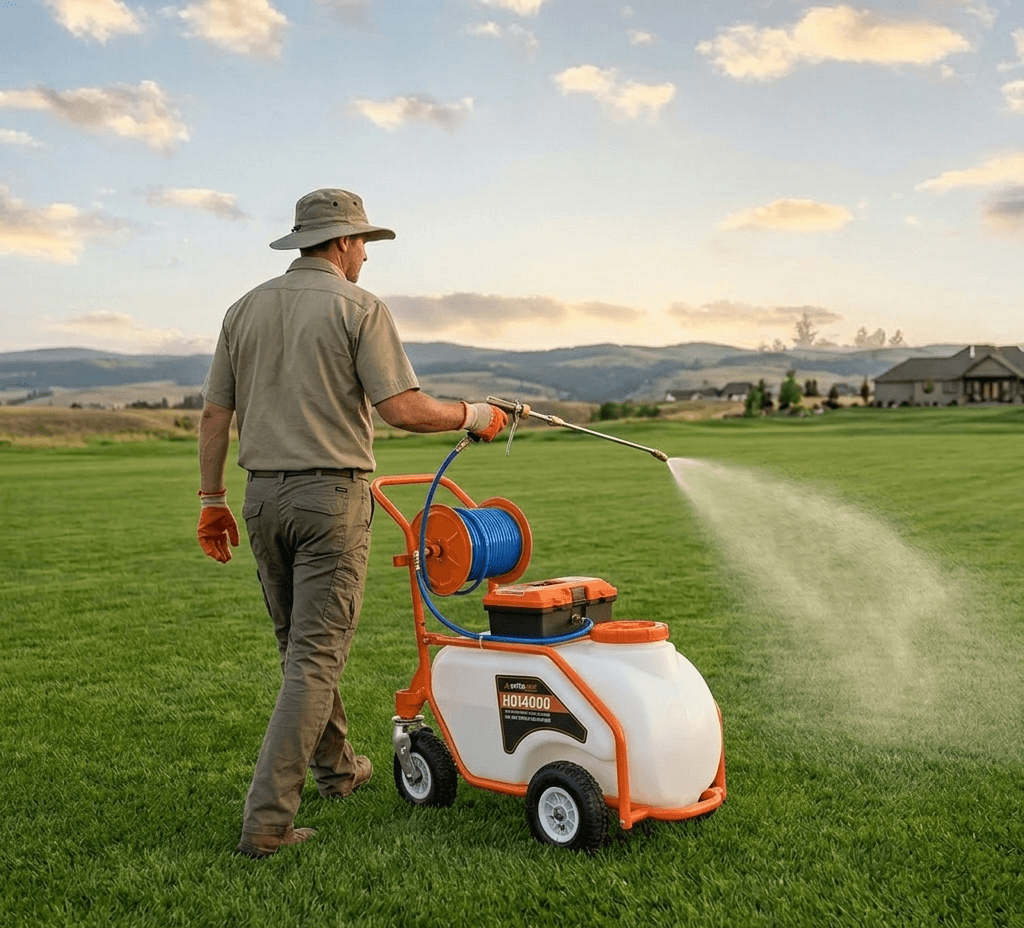
Cart sprayers shift the workload from your shoulders to wheels. Instead of carrying liquid, you transport it mechanically, which matters more as property size increases.
Ideal Use Cases for Cart Sprayers
- Large lawns or extended fence lines
- Repetitive maintenance applications
- Flat or gently rolling terrain
- Users prioritizing endurance over agility
- Situations where refill trips waste time
For example, systems like the PetraTools HD14000 are built for sustained output and higher-volume work, making them well suited for properties where coverage and runtime are more important than tight maneuvering.
Advantages of Cart Sprayers
✔ Larger capacity reduces refill frequency
✔ No carried weight during long spray sessions
✔ Designed for consistent coverage across wide areas
✔ Lower physical fatigue over time
✔ Ideal for property-wide applications
Limitations of Cart Sprayers
✘ Requires navigable terrain
✘ Less agile in landscaped areas
✘ Storage footprint is larger

PetraTools HD14000 Pushcart Sprayer
Best for: Large properties, farms, orchards, commercial landscaping, high-volume applications
Key features: 6–8 hrs battery life, 130-ft commercial hose with storage reel, 7 nozzles, steel frame with pneumatic wheels, no manual pumping
Availability: In stock — $699.99
Buy ProductThe “Hybrid Workflow” Option: When You Want Flexibility Without Choosing Just One Style
Some properties do not fall neatly into backpack-only or cart-only use. You may have open lawn areas one day and detailed spraying the next.
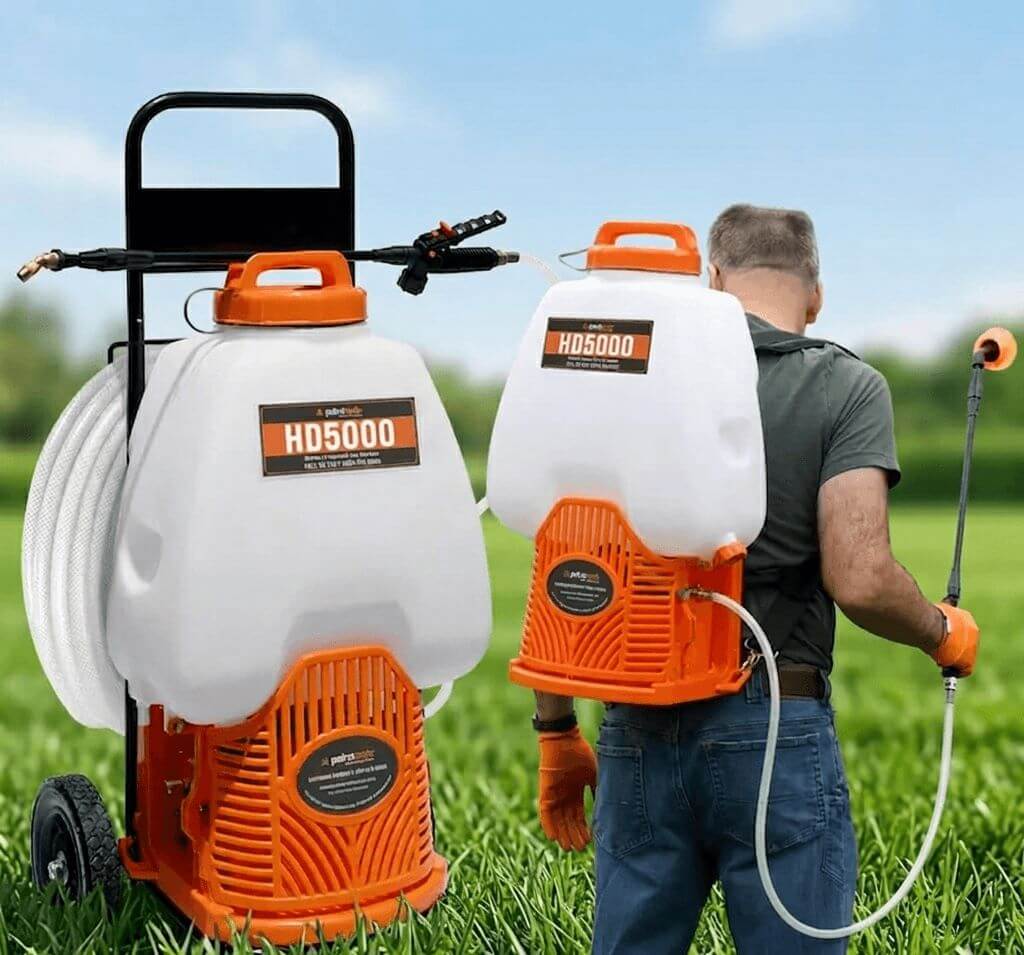
This is where a hybrid-style workflow becomes valuable. Rather than committing fully to carrying weight or relying entirely on wheels you can use a sprayer designed to give you the reach, mobility, and reduced fatigue of a cart while still allowing controlled application similar to backpack spraying.
A model like the PetraTools HD5000 Battery Sprayer with Custom Cart supports this middle-ground approach. It lets you cover larger areas efficiently while still working around beds, structures, and perimeter zones without feeling locked into one mode of movement.
Why This Approach Works for Many Homeowners
✔ Balances capacity with maneuverability
✔ Reduces lifting without sacrificing control
✔ Adapts to mixed-property layouts
✔ Useful for users who spray different zones seasonally
This is less about a new category of sprayer and more about matching equipment to properties that require both coverage and adaptability.
Backpack vs Cart Sprayer: Side-by-Side Comparison
Here’s how the two formats compare in practical use:
| Feature | Backpack Sprayer | Cart Sprayer |
|---|---|---|
| Mobility | Highest | Moderate |
| Tank Capacity | Medium | Larger |
| Best Terrain | Uneven/complex | Flat/open |
| Fatigue Type | Weight on shoulders | Pull resistance |
| Refill Frequency | More frequent | Less frequent |
| Precision Work | Excellent | Good |
| Large Area Efficiency | Moderate | Excellent |
| Storage Size | Compact | Larger footprint |
Property Size Is Usually the Deciding Factor
A simple rule many buyers discover after the fact:
- Small to medium property = backpack efficiency
- Large open property = cart efficiency
If you spend more time walking back to refill than spraying, you probably chose too small a system.
If you spend more time maneuvering equipment than applying product, you probably chose too large a system.
For example, treating a 10,000 sq. ft. lawn feels very different from maintaining a half-acre or more, even if the task itself is the same.
Terrain Matters More Than People Expect
Many buyers underestimate how frustrating wheels become on:
- Tree-rooted lawns
- Stone paths
- Garden beds
- Sloped ground
- Gates and transitions
Backpack sprayers ignore all of that. They go wherever you go.
Cart sprayers reward properties designed for movement, not navigation.
Application Type Is an Important Consideration
Choose Backpack If You Regularly:
- Spot spray weeds
- Treat ornamental beds
- Apply targeted pest control
- Work around structures
Choose Cart If You Regularly:
- Blanket spray turf
- Maintain acreage
- Apply seasonal lawn treatments
- Cover long fence or perimeter runs
Runtime and Battery Performance Considerations
Modern battery-powered sprayers have largely removed the pumping fatigue older models required. The decision now is less about pressure generation and more about how long you can operate without interruption.
Backpack units prioritize balance and wearable comfort.
Cart units prioritize sustained delivery across distance.
Neither is inherently better. They are optimized differently.
This is especially important when applying lawn fertilizers, weed control, or perimeter treatments that require consistent coverage.
Cost vs Value: Buy for Workflow, Not Price Tag
Many homeowners initially compare price instead of application style. That can lead to overspending on capacity they never use or undersizing tools that create constant inefficiency.
The better question is:
Which tool reduces total effort over a full season of use?
That answer usually aligns with terrain and treatment frequency, not budget.
How to Choose the Right Sprayer for Your Situation
Ask yourself three practical questions:
- How far do I typically spray in one session?
- Do I move through obstacles or across open ground?
- Am I carrying the sprayer comfortably, or wishing I wasn’t?
Your answers will point clearly toward one format.
Once you’ve identified which style fits your workflow, selecting a model becomes much easier.
Recommended Sprayers by Property Type
Once you determine which format fits your workflow, choosing a model comes down to capacity, runtime, and how often you plan to spray. Below are examples aligned to the use cases discussed above.
How These Recommendations Were Selected:
The sprayers highlighted below are based on a combination of hands-on product testing, performance evaluation across common residential use cases, and consistent feedback from verified customer reviews. The goal is to match equipment style to real property needs rather than promote a one-size-fits-all solution.
For Mobility-Focused Properties: Backpack Style
Recommended Model: PetraTools HD4000 Battery-Powered Backpack Sprayer
Why It Stands Out
The HD4000 consistently performs well for homeowners who need freedom of movement. Testing showed strong pressure consistency and comfortable wear during extended applications, while customer feedback frequently highlights reliability for seasonal lawn care, pest control, and spot treatments.
What Users Like Most
- Balanced weight that does not feel top-heavy
- Long battery life that covers typical residential jobs in one session
- Easy maneuverability around beds, fences, and uneven terrain
Best Fit: Properties where precision and mobility matter more than tank size.
Buy ProductFor Larger Lawns and Extended Coverage: Cart Style
Recommended Model: PetraTools HD14000 (Petra Prime Series)
Why It Stands Out
The HD14000 earns strong marks in environments where coverage efficiency is critical. Its higher-capacity design reduces refill interruptions, and reviewers frequently mention time savings when treating expansive lawns or multi-zone properties.
What Users Like Most
- Designed for sustained spraying without constant stops
- Ideal for wide, open terrain
- Reduces physical strain compared to carried systems
Best Fit: Homeowners maintaining large lawns, acreage-style layouts, or frequent full-property applications.
Buy ProductFor Mixed-Use Properties That Need Flexibility: Hybrid Cart & Backpack
Recommended Model: PetraTools HD5000 Battery Sprayer with Custom Cart
Why It Stands Out
The HD5000 is frequently chosen by users whose properties are not uniform. During evaluation, it proved especially effective for transitioning between open spraying and more controlled applications, while customer reviews often call out its balance of capacity and maneuverability.
What Users Like Most
- Combines efficiency of a wheeled unit with controlled application
- Well suited for properties that mix lawn, beds, and perimeter work
- Helps reduce carrying fatigue without sacrificing versatility
Best Fit: Homeowners who need one sprayer to handle multiple property styles.
Buy ProductFAQ: Cart Sprayer vs Backpack Sprayer
For most residential properties, battery-powered sprayers provide more consistent pressure and reduce fatigue, especially when treating larger areas or spraying regularly.
It is easier physically over long sessions, but only if your terrain allows smooth movement.
They tend to suit mixed-use residential properties where flexibility matters more than volume.
Spray distance is determined by pressure and nozzle setup, not whether the unit is wheeled or worn.
Cart sprayers often hold more solution, so they reduce refill interruptions.
Yes. The difference is delivery method, not chemical compatibility.
The Bottom Line
This is not a question of which sprayer is “better.”
It is a question of which one matches the rhythm of your property.
Backpack sprayers favor movement and adaptability.
Cart sprayers favor endurance and coverage.
Choose the one that works with your landscape instead of against it, and every application after that becomes easier.
The right sprayer should feel like it fits your property the first time you use it.