

Why Grass Seed Mats Have Become So Popular
Bare patches in a lawn create instant frustration. Traditional seeding can feel unpredictable, messy, and vulnerable to washout, birds, and uneven growth. Grass seed mats promise something much simpler: roll it out, water it, and let it fill in.
But homeowners often wonder if they are paying for convenience instead of results. The reality sits somewhere in between, and success depends heavily on how and where they are used.
Quick Recommendation Box:
Are grass seed mats for you?
Grass Seed Mats Are Best For:
- Patching, not planting whole lawns
- Slopes and runoff areas
- Fast cosmetic repair
- Homeowners who want predictable results
What Is a Grass Seed Mat, Exactly?
A grass seed mat is a biodegradable layer embedded with:
- Pre-spaced grass seed
- Organic growing medium
- Moisture-retention material
- A stabilizing mesh that holds everything in place
Instead of spreading seed, the mat creates a controlled germination environment that protects seed from displacement and drying out.
Buy Product3-in-1 Roll: Seed, Mulch & Fertilizer
How We Tested Grass Seed Mats
We evaluated grass mats across three common lawn-repair scenarios:
- Patch repair in an established lawn
- Slope repair where seed typically washes away
- High-traffic area with compacted soil
We monitored:
- Germination rate
- Fill-in uniformity
- Moisture retention
- Installation time
- Resistance to erosion or movement
This reflects real homeowner conditions, not greenhouse environments.
Installation: Easier Than Traditional Seeding
Grass seed mats are straightforward to install, but preparation matters more than most people expect.
Basic Steps:
- Loosen topsoil 1 to 2 inches deep
- Remove debris and level the surface
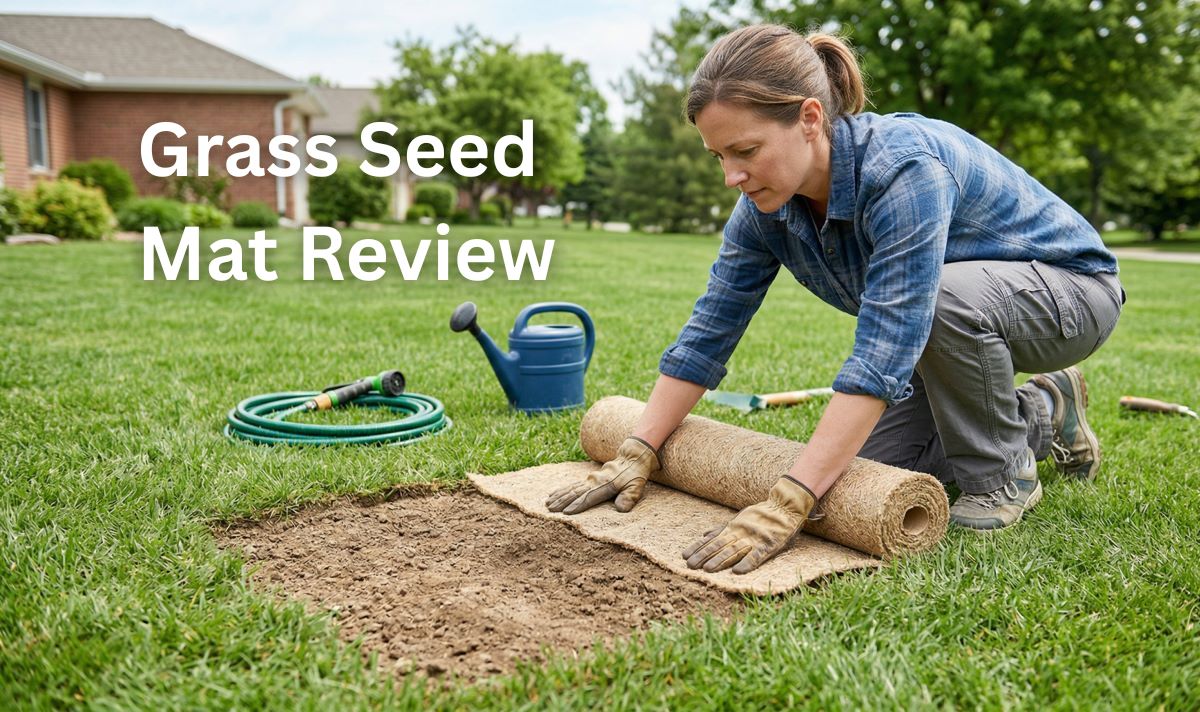
- Roll out the mat and secure contact with soil
- Water thoroughly to activate the growing medium
- Keep consistently moist during germination
Install time averaged 10 to 15 minutes per patch, significantly faster than traditional overseeding methods.
The mat must sit flush against soil. Air gaps reduce germination more than anything else.
Germination Results: Do They Actually Grow?
Where Grass Seed Mats Performed Best:
Grass seed mats showed strong germination consistency, especially in areas where loose seed typically fails.
We observed:
- More uniform sprouting patterns
- Less seed displacement after watering
- Improved early moisture retention
The mat essentially acts like a protective blanket, stabilizing the environment during the most vulnerable stage of growth.
Where Grass Seed Mat Fell Short:
Grass seed mats did not outperform traditional seeding in:
- Large-area lawn renovations
- Poor soil that lacked nutrients
- Shaded areas without proper grass selection
The mat helps seed stay put, but it does not replace healthy soil conditions.
The Biggest Advantage: Erosion Control
Seed mats clearly performed best on slopes and runoff-prone areas.
Loose seed in the same environment shifted after watering, while the mat held everything in place. This makes them especially useful for:
- Drainage paths
- Edges of walkways
- Small hills
- Areas prone to washout
In these scenarios, they solve a physical problem rather than just a planting one.
The Missing Piece Most People Overlook: Fertility
Grass mats include a starter medium, but they are not designed to fully nourish long-term growth. That is where many users see initial sprouting followed by slow development.
Most mats include a starter layer, but they are not meant to feed the grass long term. Adding fertilizer helps keep the grass growing strong and keeping the area consistently moist is what really makes the seeds take off.
Products like Neighbor’s Envy Lawn Fertilizer or PetraMax Fertilizer Max help support sustained growth once germination begins, providing nutrients the mat itself cannot supply long term.
Think of the mat as getting the grass started, while fertilizer keeps it growing strong.
Cost vs Convenience: Are They Worth It?
Here’s how mats compare to traditional seeding in real use:
| Factor | Grass Seed Mats | Traditional Seeding |
|---|---|---|
| Installation Effort | Very low | Moderate |
| Seed Protection | High | Low |
| Best For | Repairs & slopes | Large areas |
| Cost per sq. ft. | Higher | Lower |
| Germination Consistency | Reliable | Variable |
| Skill Required | Minimal | Moderate |
Grass seed mats trade material cost for predictability and ease.
When Grass Seed Mats Make Sense
Ideal Use Cases:
- Fixing small lawn patches
- Stabilizing slopes or edges
- Quick seasonal repairs
- Preventing seed washout
- Homeowners wanting a simple solution
Not Ideal For:
- Entire lawn installations
- Extremely poor soil conditions
- Situations needing major grading or prep
They are a targeted repair tool, not a full lawn replacement strategy.
How to Get the Best Results (This Matters More Than the Mat)
Success depended far more on preparation and watering than the product itself.
Do This:
✔ Loosen soil before installation
✔ Maintain consistent moisture for 10 to 14 days
✔ Add fertilizer after germination begins
✔ Ensure full mat-to-soil contact
Avoid This:
✘ Placing mats on hard or compacted ground
✘ Letting mats dry out during early growth
✘ Expecting them to fix poor soil automatically
Grass still needs to grow. The mat simply gives it a better start.
Watering Schedule for Grass Seed Mats
| Stage | Frequency | Goal | What It Should Look Like |
|---|---|---|---|
| Day 1 – 3 | Light watering 2 – 3 X per day | Keep mat fully moist | Mat stays dark, never dries out |
| Day 4 – 10 | Water 1 – 2 X per day | Support germination | Soil feels damp, not soggy |
| After sprouting | Water once daily | Encourage root growth | Surface can dry slightly between watering |
| After 3 weeks | Transition to normal watering | Establish turf | Deep watering, less frequent |
If the mat turns light brown or crispy, it dried out and germination may stall.
Realistic Expectations: What Grass Seed Mats Can and Cannot Do
Grass seed mats can:
- Improve germination consistency
- Prevent seed movement
- Simplify patch repair
- Reduce installation guesswork
They cannot:
- Replace soil preparation
- Fertilize a lawn long term
- Fix drainage or compaction issues
- Perform miracles without water
They are a tool, not a shortcut.
FAQ: Grass Seed Mats
They work more predictably in small areas, especially where seed movement is a problem.
Most germination begins within 7 to 14 days depending on temperature and moisture.
Yes. The mat helps start growth, but fertilizer supports continued development.
Once grass reaches mowing height, the biodegradable material has already begun breaking down.
They are better suited for targeted repair rather than full-lawn seeding.
No. The mesh structure helps hold seed in place, which is why they perform especially well on slopes compared to loose seed.
The Bottom Line
Grass seed mats do work, but not because they are magical. They work because they solve very specific problems: seed displacement, uneven spacing, and moisture inconsistency.
Used in the right situation, they make lawn repair easier and more reliable. Used everywhere, they become unnecessarily expensive.
Match them to patching, erosion-prone spots, and controlled repairs, and they become a smart addition to your lawn care toolkit rather than a replacement for it.