


Understanding Spring Lawn Timing – Before You Start
Grass doesn’t care what the calendar says. It responds to what’s happening in the soil.
Most cool-season lawns don’t really wake up until soil temperatures reach around 50°F, even if you’ve already had a few warm, sunny days.
In northern regions this may happen in late March or April, while warmer zones may reach these temperatures weeks earlier. Soil conditions matter more than the date on the calendar.
Jump in too early and you’re spinning your wheels. Wait too long and weeds get a head start.
A good spring lawn care plan is all about timing and order:
Clean → Correct → Feed → Prevent → Strengthen
Follow that sequence, and your lawn has a much better chance of filling in thick and healthy before summer stress arrives.
Your Spring Lawn Care Plan at a Glance
If you want the simple version before getting into the details, here’s how spring lawn care typically breaks down month by month.
| Month | Focus | What You’re Trying to Accomplish | Key Actions |
|---|---|---|---|
| March | Wake-Up | Help the lawn recover from winter and prepare for growth | Clean debris, light raking, inspect damage, monitor soil temps |
| April | Repair & Prevent | Fix underlying issues and stop weeds before they start | Aerate if needed, dethatch selectively, apply first fertilizer, apply pre-emergent |
| May | Strengthen & Maintain | Build density and encourage healthy, even growth | Light second feeding, mow properly, water deeply, spot-treat weeds |
Think of March as preparation, April as correction, and May as strengthening.
Each month builds on the one before it, which is why timing matters more than doing everything at once.
March Lawn Care Checklist: Wake-Up Phase
March is about inspection and gentle preparation, not aggressive treatment.
What To Do:
✔ Remove debris, branches, and matted grass
✔ Lightly rake to improve airflow
✔ Check for snow mold or compacted areas
✔ Begin monitoring soil temperatures
✔ Service equipment before the season begins
What NOT To Do Yet:
✘ Heavy fertilization
✘ Aggressive dethatching
✘ Seeding (soil still too cold)
At this stage, the lawn is just starting to wake up. You’re easing it back into growth, not trying to push it too fast.
April Lawn Care Checklist: Correction Phase
April is where real improvement begins. The lawn can now absorb nutrients and recover from mechanical work.
Key Tasks:
✔ Core aerate compacted areas
✔ Dethatch only if buildup exceeds ½ inch
✔ Apply first feeding to support root development
✔ Apply pre-emergent weed control (timing matters)
✔ Repair thin areas if needed
Why Fertilizing Now Matters:
Fertilizing in spring should help the lawn recover at a steady pace, not grow too fast all at once. Feeding it the right way helps the grass fill in thicker, which naturally helps keep weeds from taking over.
May Lawn Care Checklist: Strengthening Phase
May is where consistency pays off. The groundwork laid in March and April starts to show visible improvement.
Focus Areas:
✔ Apply a second, lighter fertilizer application if needed
✔ Maintain mowing height around 3–3.5 inches
✔ Water deeply but infrequently
✔ Spot treat emerging weeds
✔ Monitor turf density rather than chasing color alone
At this stage, you are reinforcing strength, not restarting the process.
Once you know what needs to be applied each month, the next step is making sure those treatments go down evenly.
Choosing the Right Equipment for Efficient Application
Pump Sprayers: Best for Spot Treatments
Ideal for targeted weed control, edging, and small-area fertilization where precision matters more than speed. A compact pump sprayer like the PetraTools HD101 is useful for treating problem areas without dragging out larger equipment. It’s the right tool when you want control, not coverage.
Backpack Sprayers: Consistent Coverage Across Larger Lawns
For most homeowners, backpack sprayers hit the sweet spot between efficiency and accuracy. Models like the PetraTools HD3000 or PetraTools HD4000 allow you to move comfortably across the yard while maintaining steady pressure and even application. That consistency helps prevent striping, missed zones, or over-application, which is especially important when applying fertilizers or lawn solutions.
Cart Sprayers: Built for Large Capacity
When you’re covering bigger properties or want to minimize refilling, a cart-style unit like the HD14000 becomes a major time-saver. The larger capacity and wheel-supported design make it easier to apply treatments across wide areas with uniform coverage and less physical strain.

PetraTools HD14000 Pushcart Sprayer
Best for: Large properties, farms, orchards, commercial landscaping, high-volume applications
Key features: 6–8 hrs battery life, 130-ft commercial hose with storage reel, 7 nozzles, steel frame with pneumatic wheels, no manual pumping
Availability: In stock — $699.99
Buy ProductHelpful Tip:
Choosing the right sprayer isn’t about having more equipment. It’s about matching the tool to the size of the job so applications go down evenly and efficiently the first time.
If you’re planning your spring applications now, this is a good time to make sure your equipment matches the size of your lawn and the type of treatments you’ll be applying.
Fertilization Strategy That Supports Growth Instead of Forcing It
Spring nutrition should encourage balanced turf recovery.
A balanced slow-release fertilizer is typically recommended at this stage.
Products like PetraMax Lawn Fertilizer Max are designed to support that kind of steady nutrient delivery early in the season, while Neighbor’s Envy is typically used to reinforce density and color once the lawn is actively growing.
The goal is not fast green-up.
The goal is durable turf that holds through summer stress.
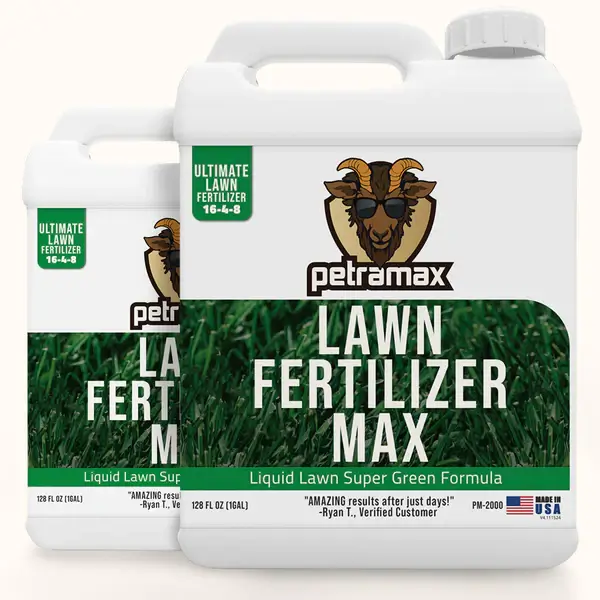
PetraMax Liquid Fertilizer Max
Best for: Lawn greening, root development, all grass types, spring & summer feeding, disease resistance
Key features: 16-4-8 NPK, quick & slow-release nitrogen, chelated iron, pet-friendly, treats up to 12,800 sq. ft.
Availability: In stock, starting from $78.99
Buy ProductCommon Spring Mistakes to Avoid
Starting Too Early: Cold soil prevents nutrient uptake.
Over-Dethatching Every Year: Many lawns don’t need it annually.
Heavy Fertilizer Applications: Creates weak, fast growth prone to stress.
Ignoring Application Consistency: Uneven distribution leads to patchy results.
Lawn conditions vary based on grass type, region, and soil quality, so slight adjustments to timing may be needed.
FAQs: Spring Lawn Care Questions Homeowners Ask
Begin when soil temperatures consistently reach 50°F, not based on air temperature alone.
Only if soil is compacted or traffic is heavy. Many residential lawns benefit every 2–3 years.
Most lawns respond best to two lighter applications rather than one heavy feeding.
Consistency. Even application, proper timing, and realistic expectations outperform aggressive treatments.
Final Thought
Spring lawn care isn’t about doing more.
It’s about doing the right things at the right time, with the right tools, and letting turf biology handle the rest.
When each month is handled deliberately, the lawn builds density, resilience, and root strength that carry through summer.
That rhythm builds lawns that last far beyond spring.